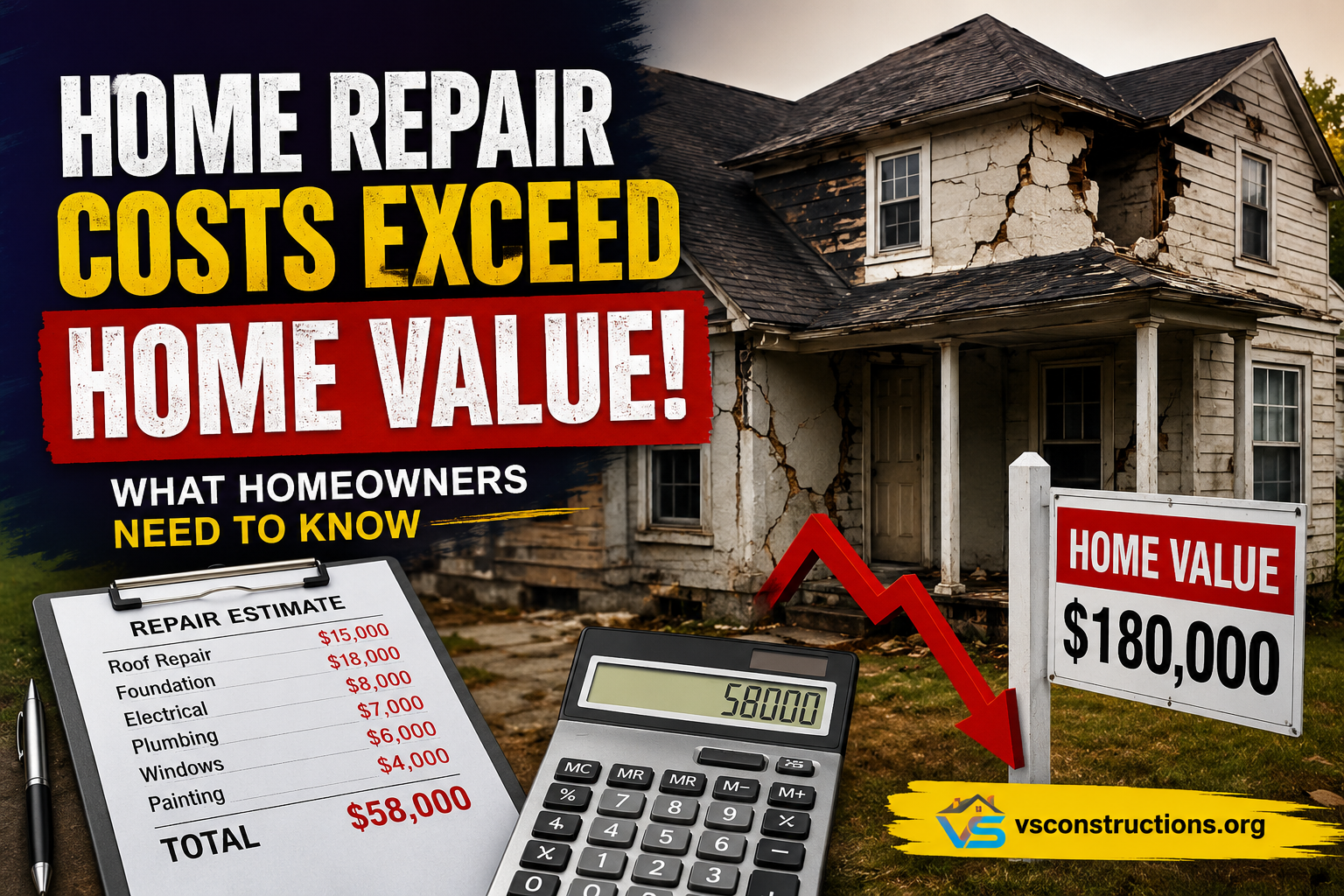
I buy houses for a living, and most weeks I walk at least one property where the repair bill has quietly outgrown the owner’s ability to pay it. A roof that’s been leaking since two storms ago. A crawlspace with joists you can push a thumb into. A kitchen that hasn’t been touched since the Carter administration. The owner almost always asks me the same question: should I fix it or sell it the way it sits? After hundreds of these walkthroughs, I can tell you the honest answer is usually not the one the renovation shows suggest.
Why repair estimates balloon on older homes
Contractors know this better than anyone. You open a wall to fix one problem and find three more behind it. On paper, a roof replacement might run fifteen to twenty thousand. But older homes rarely fail in just one place. The same deferred maintenance that killed the roof has usually been working on the fascia, the attic insulation, and the ceiling drywall too. By the time a homeowner gets three real bids, the number they’re staring at is often double what they braced for.
That’s the moment the math changes. A homeowner with a paid-off house worth 250k after repairs, facing 80k of work, isn’t really deciding whether to renovate. They’re deciding whether to become a general contractor for six months, finance the work at today’s rates, and hope the market holds while they do it. Most people with a job, kids, or an inherited property three states away simply can’t take that project on, and pretending otherwise just costs them another year of decay.
The three paths, and what each one really costs
The first path is doing the work. It nets the most on paper, and if you have the cash, the time, and the stomach for it, it can be the right call. What the paper number hides is carrying cost. Every month of renovation is another month of taxes, insurance, utilities, and loan interest, plus the surprises behind the walls. I’ve watched an 80k budget become 110k with nothing to show for the difference except code compliance.
The second path is listing as-is on the open market. It works, but financed buyers struggle here. Lenders don’t love homes with active leaks or dead HVAC, appraisals come in rough, and deals fall apart at inspection. The house sits, the listing goes stale, and every price cut tells the next buyer to offer less.
The third path is selling directly to a cash buyer who takes the house in its current condition. The trade is simple and worth stating plainly: you give up a slice of the after-repair value in exchange for speed, certainty, and never writing a check to a contractor. The buyer prices in the repairs, closes in days or weeks instead of months, and the seller walks away clean. For a house that needs cosmetic touch-ups, that trade is usually a bad deal. For a house that needs structural work, a new roof, and full mechanicals, it’s often the best net outcome once you count carrying costs and risk. When I make an offer through my company, Creative House Offer, I put the repair math on the table line by line, because a seller who understands the numbers makes a better decision, whichever path they pick.
What construction pros should tell homeowners in over their heads
If you’re a builder or remodeler, you meet these owners before I do. They call you for a bid, and you can see in their face that the number isn’t going to work. The kindest thing you can do is give them the full picture. Tell them what the work really costs, including the stuff you can’t see yet. Tell them what the house would be worth finished, and let them do the subtraction themselves. And when the gap is too wide, tell them there’s a third door. A referral to a reputable as-is buyer isn’t a lost job. It’s the answer that fits, and homeowners remember the contractor who told them the truth.
The homes themselves usually end up better for it too. Most cash buyers are renovating for resale or rental, which means the house that was rotting gets the new roof, the rewire, and the permit-pulled work the previous owner couldn’t fund. The block gets an occupied, updated home instead of a slow-motion demolition. I’ve bought houses where the neighbors thanked me at the closing table, which tells you how long they’d been watching the tarp on the roof.
The bottom line
A house that needs major work isn’t a tragedy. It’s a math problem with three answers, and the right one depends on the owner’s cash, time, and appetite for risk. Fix it if you can truly afford the whole ride. List it as-is if the damage is light enough for financed buyers to swallow. And when the repairs have outgrown the owner, a direct as-is sale is the honest exit, not the desperate one. The worst outcome is the fourth path nobody chooses on purpose: waiting another year while the water keeps finding its way in.